


Jagga Smith is the clear favourite to win the AFL Rising Star Award tomorrow night.
But as we’ve seen with Nick Daicos at the Brownlow and the Copeland Trophy in recent years, the favourite doesn’t always win.
In an attempt to calm my nerves, I’ve turned to the data to prepare a series of talking points that can either be used to champion Smith’s achievements from his debut season, or cheer myself up if he fails to become just the second Blue, after Sam Walsh in 2019, to be awarded the Ron Evans Medal.
As we continue to build at The Gardiner Stand, we’re committed to keeping our coverage away from paywalls. If you are in a position to, please consider your support on Ko-Fi.
Let’s start with Smith’s nomination.
Smith made his debut against Sydney in Opening Round but was overlooked for a nomination despite registering 27 disposals, five contested possessions, two tackles, three clearances and four inside 50s. Perhaps the fact that the Blues were badly beaten worked against him?
But the smooth-moving midfielder didn’t have to wait long for his name to be called, getting the nod the following week when Carlton hung on to take the four points against Richmond at the MCG. Getting the ball 15 times in the first quarter was probably enough to sew up the nomination.
Eight of the 33 Rising Star winners were nominated in the first two rounds of the season, with 14 more coming before Round 7. Only four players have won the award after being nominated beyond Round 10: Ben Cousins in 1996 and Daniel Talia in 2012 (Round 12), Justin Koschitzke in 2001 (Round 14) and Callum Mills in 2016 (Round 16).
So far, so good.
Next, let’s consider how many games Smith has played.
After missing his entire rookie season due to a ruptured ACL, the former Oakleigh Charger has played every game in 2026 and is set to experience finals footy in his first year.
Of the previous 33 Rising Star Award recipients, 17 played all possible home-and-away games for their side that year — including the last four winners: Nick Daicos, Harry Sheezel, Oliver Dempsey and Murphy Reid.
Plenty of precedent would still have existed for Smith to succeed had he been ruled out or rested against the Dockers. Four players have taken out the award despite missing one game: Paul Hasleby in 2000, Sam Mitchell in 2003, Jared Rivers in 2004 and Luke Jackson in 2021.
Heck, five players have won the award after missing two games, most recently Andrew McGrath in 2017. Four have won after missing three, two after missing four, and one player was deemed the best young player in the competition after missing seven games — Nick Holland in 1995, if you’re curious.
We can also consider how much impact nominees exert on the game.
Jagga Smith has the highest average player rating — Champion Data’s metric of choice when measuring the impact an individual player has on a game — among the crop of 2026 nominees who have played more than five games.
The third overall pick of the 2024 National Draft averaged 11.0 points from his 23 games, ahead of Greater Western Sydney’s Phoenix Gothard (9.7 in 16 games before dislocating his shoulder) and Collingwood’s Sam Swadling (9.2 in eight games). West Coast’s Willem Duursma is further back, averaging 8.4 points.
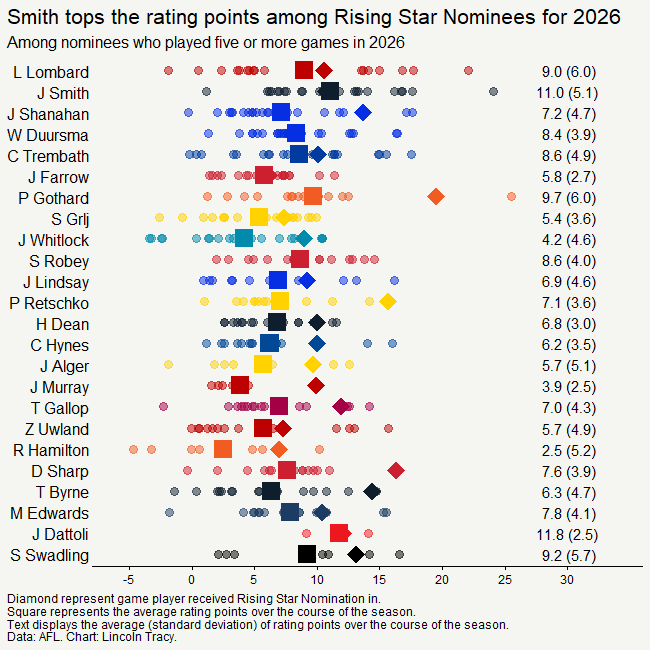
However, as I said off the top, the best — or most impactful — player doesn’t always win when it comes to handing out awards. This seems especially true when considering rating points.
Between 2012 and 2025, there has only been one instance where the highest-rated nominee went on to win the Ron Evans Medal: Jaeger O’Meara in 2013. Playing for Gold Coast, O’Meara averaged 11.34 rating points while playing every game of the Suns’ third season in the AFL.
In fact, the highest-rated nominee has had a better chance of finishing on either side of the Rising Star podium than standing in the middle. Marcus Bontempelli (2014), Patrick Cripps (2015), Sydney Stack (2019), Jai Newcombe (2022), Will Ashcroft (2023) and George Wardlaw (2024) all finished in the top three despite being the No.1-rated nominee.
Three top-rated Rising Star nominees have even failed to receive a vote from the judging panel: Dylan Shiel in 2012, Matt Rowell in 2020 and Chad Warner in 2021 — although all three missed considerable chunks of their seasons through injury.
Shiel played 12 games before being shut down for the year and undergoing foot surgery. Rowell burst onto the scene in 2020 but managed just five games before a season-ending shoulder dislocation against Geelong, while Warner played the first 12 games of 2021 before a stress fracture in his fibula sidelined him until the Elimination Final.
So perhaps player ratings aren’t quite the security blanket I was looking for.\
What about the coaches’ votes?
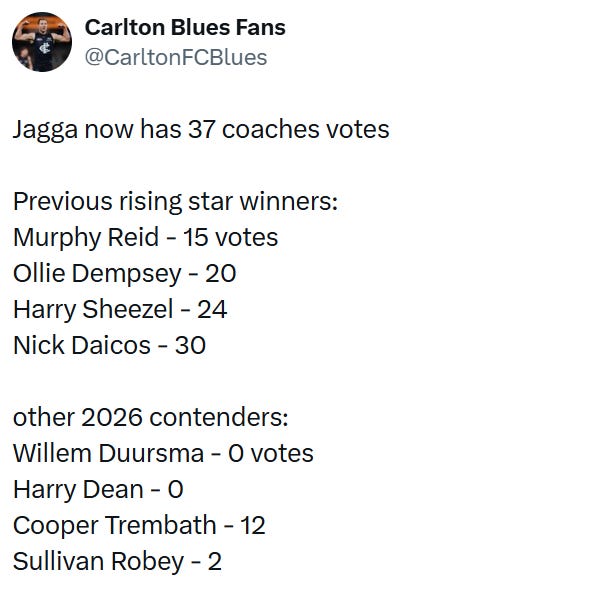
Smith has been awarded coaches’ votes in nine games this season. North Melbourne’s Cooper Trembath is next best in this metric with three, ahead of Jobe Shanahan with two. No other nominee has polled in more than one game — noting that the coaches’ votes for Rounds 22, 23 and 24 won’t be released until the AFL Awards night on August 25.
Smith has received 52 coaches’ votes across those nine games — more than any other nominee has received over the course of a full season since 2004 — including a perfect 10 in Carlton’s 76-point drubbing of Brisbane in Round 21.
He’s the only Rising Star nominee to receive 10 votes in a game this year and has four times as many coaches’ votes as the next player, Trembath, with 13. Harry Dean and Duursma, considered Smith’s two most credible challengers in the Rising Star race, haven’t polled a vote between them.
Smith’s 52 votes, at the time of writing, also set a new record for coaches’ votes polled by a Rising Star nominee in the season they were nominated, surpassing Hawthorn’s Jai Newcombe and West Coast’s Luke Shuey, who each received 44.
The 20-year-old’s tally also surpasses the coaches’ votes received by the four players who have unanimously won the Rising Star Award since 2004: Jared Rivers in 2004 (11 votes from three games), Daniel Rich in 2009 (23 from four), Dan Hannebery in 2010 (29 from four) and Nick Daicos in 2022 (30 from five).
Surely that’s enough?
Well...I’ve said it before, and I’ll say it again: being the highest scorer in a particular metric doesn’t guarantee success when it comes to winning the Rising Star.
Since 2011, there have been just two nominees who finished the year with the most coaches’ votes and were awarded the Ron Evans Medal: Jaeger O’Meara in 2013, polling 32 votes in seven games, and Sam Walsh in 2019, with 26 votes in eight.
The nominee with the most coaches’ votes has actually been more likely to finish second in the Rising Star voting over the past 15 years: Shuey in 2011, Patrick Cripps in 2015, Caleb Daniel in 2016, Ryan Burton in 2017, Tom Green in 2021, Will Ashcroft in 2023 and Dan Curtin in 2025.
There have also been four instances where the nominee with the most coaches’ votes failed to poll a single Rising Star vote: Toby Greene in 2012, Jake Stringer in 2014, Matt Rowell in 2020 and Harley Reid in 2024. Rowell, of course, missed most of 2020 through injury, while Reid was ineligible to win in 2024 after being suspended.
And three Rising Star winners have ranked 10th or lower for coaches’ votes among that year’s nominees: Daniel Talia in 2012, Lewis Taylor in 2014 and Callum Mills in 2016.
So, after all that digging, what have I learned?
Jagga Smith has put together a debut season worthy of winning the Rising Star. The numbers tell us that much.
Whether the judges agree is another matter entirely.
Let’s hope Jagga’s name is the one called tomorrow night.
And if it isn’t? Well, I’ve just spent all this time preparing myself for that possibility.
Subscribe to Lincoln Tracy’s Blog Follow him on Instagram here.
